Audit Readiness Software for Behavioral Health Providers: How to Keep HR Records Review Ready Every Day
Behavioral health organizations rarely get the luxury of preparing for an audit on a quiet schedule. A payer review, accreditation visit, funding oversight request, or internal compliance check can surface with very little notice. When HR records live across inboxes, shared drives, paper files, and disconnected spreadsheets, staff end up scrambling to prove the same things over and over again.
That is why many providers are now looking for audit readiness software that supports HR operations, not just abstract compliance reporting. For behavioral health teams, readiness depends on having a consistent system for employee files, onboarding records, credential documentation, training evidence, supervision support, and expiration tracking.
Key Takeaways
What Audit Readiness Software Means for Behavioral Health HR
Audit readiness software helps an organization keep required records complete, current, and easy to retrieve before someone asks for them. In a behavioral health setting, that includes far more than a folder of basic employee forms. HR teams may need to show job descriptions, signed policies, licensure and certification records, training completion, onboarding acknowledgements, background screening documentation, supervision evidence, and proof that required items were reviewed on time.
The goal is not to create more documentation for its own sake. The goal is to create a repeatable operating system for workforce compliance so that audits feel like a records review, not an emergency project.
Why It Matters More in Behavioral Health
Behavioral health providers often manage multiple program types, service locations, funding requirements, and staff roles at the same time. Different employees may need different combinations of training, credentials, supervision, and documentation depending on the populations they serve. That complexity creates a real risk when HR data is scattered.
Even strong teams can run into trouble when there is no centralized workflow. A document may exist but be saved in the wrong place. A license may be current but not reflected in the employee file. A supervisor may have completed a review but not stored the evidence consistently. In an audit, missing proof is often treated the same as missing action.
That is why readiness has to be operational, not occasional. If records are not maintained continuously, they become harder to defend later.
Common Gaps That Make Audits Harder
These problems usually do not come from carelessness. They come from growth, staff turnover, inconsistent workflows, and systems that were never designed for compliance-heavy healthcare environments.
What to Look for in Audit Readiness Software
Centralized digital employee files
Audit readiness gets much easier when every employee has a structured digital record. The right platform should make it simple to store required documents by category, keep files attached to the correct employee, and retrieve them quickly when questions come up.
Standardized onboarding workflows
New hire documentation should follow a repeatable path instead of depending on memory. Software should support checklists, required document collection, and clear visibility into which onboarding steps are complete or still outstanding.
Expiration and renewal tracking
Licenses, certifications, trainings, and policy acknowledgements all have timelines. A good system should help teams monitor deadlines in advance so missing renewals do not become audit findings later.
Role-based visibility and secure access
Behavioral health providers handle sensitive employee information, so audit readiness cannot come at the cost of privacy. The platform should support controlled access so HR, supervisors, and leadership can see what they need without exposing everything to everyone.
Clear reporting for follow-up
Teams need a simple way to identify missing items, upcoming expirations, and unresolved compliance tasks. The most useful reporting is not flashy. It tells managers what needs attention now and helps them close gaps before a reviewer sees them.
How BUAMS HR Supports Day-to-Day Readiness
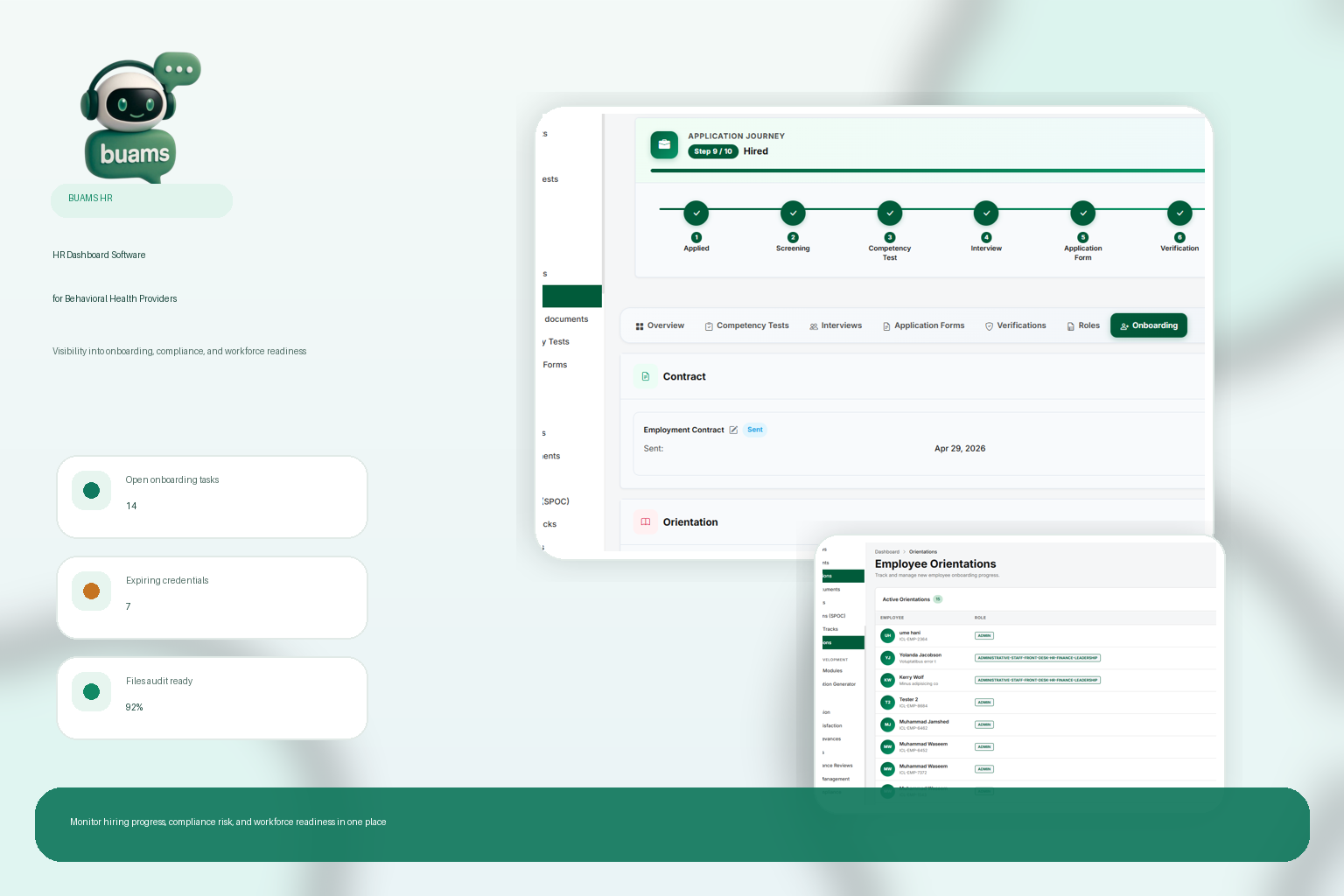
BUAMS HR helps behavioral health organizations move from reactive audit prep to continuous workforce readiness. Instead of keeping hiring records, employee files, and compliance follow-up in disconnected tools, teams can manage critical documentation in one structured environment.
With BUAMS HR, organizations can standardize onboarding requirements, organize employee records, track time-sensitive compliance items, and reduce the manual work involved in preparing for reviews. That means HR teams spend less time searching for documents and more time keeping records complete as part of normal operations.
For providers serving multiple programs or locations, that consistency matters. A shared workflow helps leadership see whether expectations are being met across teams, while giving HR a more reliable way to maintain documentation quality over time.
Final Thoughts
Audit readiness software should not be treated as a tool you only need when a review is coming. For behavioral health providers, it is part of building a stable HR foundation that supports compliance, protects the organization, and reduces administrative strain.
When employee records are organized, current, and easy to verify, audits become far less disruptive. More importantly, staff can spend less energy on last-minute document hunts and more energy supporting a strong, dependable workforce.